
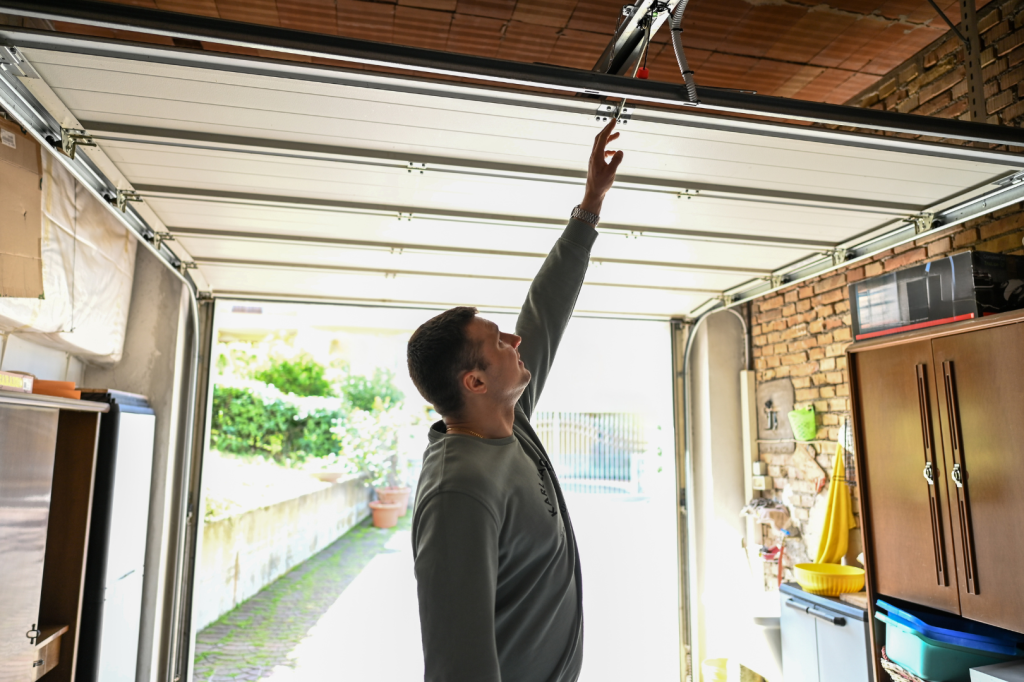
A garage door spring doesn’t announce when it’s about to fail. It gives signals, and most homeowners learn to live with them. The door feels a little heavier than it used to. The opener sounds like it’s straining during the first few feet of the lift. There’s an occasional pop that wasn’t there a year ago. And because the door still opens and closes, the repair call gets pushed down the list. We’ve been doing garage door spring repair across Greenville and the surrounding Upstate for over 22 years, and the doors we see in the worst condition are almost never the ones that failed suddenly. They’re the ones that were quietly failing for months while the homeowner waited.
What the Opener Goes Through When a Spring Fails
To understand why a failing spring matters, you have to understand what a torsion spring actually does. It stores mechanical energy that counterbalances the full weight of the door panel so the opener only needs to manage a small resistive load through the door’s travel. The spring does the heavy work. The opener manages the motion.
When that spring breaks or loses tension through metal fatigue, the counterbalance disappears. The full panel weight transfers directly to the opener’s drive system. The motor runs harder and hotter on every cycle. The nylon drive gears inside the opener housing, which are engineered to transfer torque within a specific load range, begin stripping under the elevated demand. We’ve replaced openers that were only a few years old, not because the opener was defective, but because it had been lifting an unbalanced door for months. When we open those units and look at the gear assembly, the wear pattern tells the story immediately. The damage didn’t happen all at once. It accumulated cycle by cycle until the morning the opener simply didn’t respond.
The Door Starts Moving in Ways It Shouldn’t
A garage door panel is engineered to travel vertically along a fixed track path. The track, rollers, hinges, and panel frames are all designed around the assumption that the door is balanced and moving straight. When spring tension drops unevenly or breaks entirely, that assumption no longer holds.
One pattern we come across consistently is a door where one side of the panel lifts faster than the other. From the outside it looks like a minor alignment issue. What’s actually happening is the panel frame is absorbing lateral stress it was never designed to carry, and the track is taking pressure at an angle that gradually bends the vertical section out of true. We’ve arrived on service calls where a homeowner was convinced they needed a complete door replacement. After a full inspection, the real starting point was a spring ignored long enough to warp the top panel section and push the track out of plumb. In several of those cases, a spring replacement combined with a strut reinforcement across the top panel restored the door fully. That option only exists when we catch it before the structural damage compounds.
What Happens to Cables and Drums Next
Springs, cables, and drums function as an integrated lifting system. When spring tension is correct, the cables maintain consistent contact with the drum groove throughout the door’s full travel. When spring tension drops, that consistency breaks down. The cable begins running at a slightly off-angle relative to the drum groove, causing the strands to fray against the drum edge over time.
In more advanced cases of spring neglect, particularly on proprietary torque-master style spring systems where the spring and drum are integrated, the spring failure can cause the cable to unspool from the drum entirely before the homeowner notices anything wrong. We’ve converted doors from those proprietary setups to standard torsion systems specifically because the original design failed and drove cable and drum damage that wouldn’t have occurred with a timely spring repair. What started as a spring job became a spring, cable, and drum replacement by the time we arrived.
The Safety Issue That Makes This Urgent
A torsion spring stores significant mechanical energy in its wound steel coil. That stored energy is what makes a door weighing well over a hundred pounds feel light enough to lift with one hand when the spring is correctly tensioned. When the spring breaks, that counterbalance is gone. A door with a broken spring can drop faster than the auto-reverse sensors on the opener can detect and respond to, particularly if the cable fails under the sudden load shift. We’ve seen doors come off their tracks when a cable snapped because a broken spring had been running the system out of balance for weeks.
The manual lift risk is something we hear about from customers regularly. A homeowner whose opener stops working tries to lift the door by hand, not realizing the spring is the underlying failure. Without the spring doing its job, the homeowner is lifting the full panel weight, which creates a serious risk of dropping the door or damaging the top panel by forcing it past the track stops.
Torsion spring adjustment and replacement is professional-only work without exception. The energy stored in a wound torsion spring releases violently if a winding bar slips during adjustment. It requires calibrated winding bars, the correct spring specifications for the door’s weight and height, and the experience to read how the spring responds during winding.
What Skipping the Repair Actually Costs
A spring replacement addressed at first signs of wear is a focused, single-component job. That same repair, delayed until the opener drive gears are stripped, the cable has frayed, and the track has started to bend, becomes a multi-component service call that takes significantly longer and costs proportionally more.
One situation that comes up regularly in Upstate homes is a door where the original builder installed standard springs on a heavier insulated door without matching the spring specifications to the door’s actual weight. Standard residential torsion springs are rated for approximately 10,000 cycles under correct load conditions. When a spring is undersized for the door it’s lifting, that cycle rating drops because the spring operates above its design tension on every cycle. By the time the homeowner notices the door feels heavy, the spring is often already near the end of its service life and the opener has been absorbing the difference for months.
Warning Signs That Mean the Clock Is Already Running
These are the signs that consistently tell us a spring is in its failure window. The door feels heavier than it used to when lifted manually with the opener disconnected. A properly balanced door should hold itself at waist height with minimal effort. If it drops when you let go, spring tension is insufficient. The opener sounds like it’s working harder during the first twelve inches of the lift cycle, where spring load transfer is most critical. There is a visible gap or separation in the torsion spring coil on the torsion bar above the door, which is the definitive sign the spring has snapped. The door travels unevenly, with one side leading the other. The lift cables appear loose or are visibly fraying near the bottom bracket.
The gap in the spring coil is the sign most homeowners walk past without recognizing. A healthy torsion spring has consistent spacing between coils. A broken spring has a visible separation, sometimes an inch or more, along its length.
Why Addressing This Now Protects the Whole System
Same-day garage door spring repair restores the counterbalance the entire system depends on. The opener returns to managing the load it was built for. The cables return to running at the correct angle against the drums. The door travels straight along the track. For homes where the garage is the primary entry and the door cycles multiple times daily, upgrading to high-cycle springs rated for 20,000 or more cycles at the time of replacement is a decision that pays for itself. Standard springs rated for 10,000 cycles and high-cycle springs represent a meaningful difference in a home where the door opens and closes six to eight times a day.
Most spring replacements we handle across Greenville and the Upstate are completed in a single visit. We carry the inventory for most residential spring configurations on every service vehicle, so there are no return trips for parts.
Don’t Wait on a Spring That’s Already Telling You Something
Every cycle a failing spring completes adds measurable stress to your opener’s drive system, your cables, and your door’s structural components. Garage Doors Today has over 22 years of hands-on experience handling garage door spring repair across Greenville, Greer, Spartanburg, and nearby areas throughout the Upstate. We answer the phone 24 hours a day, seven days a week, same-day service is available for most spring repair jobs, and every high-cycle spring we install carries a 5-year warranty. Reach out today and let our team assess what your spring is telling you before that conversation gets more expensive.