
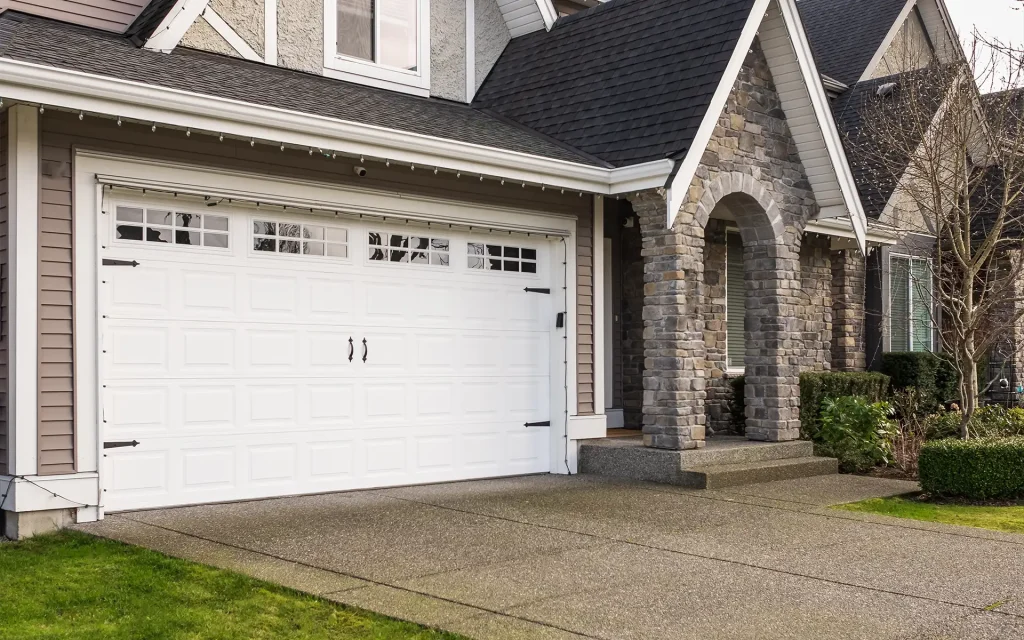
For most Greenville homes, the best garage door material is insulated, factory-finished steel because it balances humidity resistance, strength, design choice, upkeep, and price. Choose composite when you want a convincing carriage-house or wood look with less finish maintenance, and choose real wood when authentic grain and custom craftsmanship matter enough to justify regular care.
The right specification still depends on whether the garage is attached, how the opening faces the sun and rain, and how the space is used.
The Shortlist at a Glance
| Material | Best For | Greenville Climate Fit | Maintenance | Design Range | Relative Installed Price |
| Steel | Most homes, busy households, attached garages | Very good with an intact factory finish and protected edges | Low to moderate | Broad, from raised panels to modern flush and wood-look finishes | Usually the value choice |
| Real Wood | Historic character, high-end custom work, authentic grain | Fair if carefully sealed and maintained | High | Excellent for custom profiles, species, stains, and paint | Usually premium |
| Composite | Wood-look and carriage-house styling with less wood upkeep | Very good when the system and overlay are specified for exterior exposure | Low to moderate | Strong for dimensional overlays and painted or wood-look designs | Midrange to premium |
“Composite” deserves a definition. In garage doors, it often means an engineered overlay or trim applied to a steel, insulated core, not a solid slab made from one material. Amarr, for example, describes a four-layer construction of overlay, steel, insulation, and interior steel.5 Ask what every layer is made of, because the face design alone does not tell you the door’s strength, thermal performance, weight, or care requirements.
How Greenville Weather Changes the Choice
Greenville’s climate makes moisture management and solar exposure practical buying factors. NOAA’s 1991–2020 normals for the Greenville-Spartanburg station show normal July highs of 90.3°F, July lows of 69.2°F, and 4.82 inches of July precipitation. June through August each averages roughly 3.9 to 4.8 inches of precipitation.1 The U.S.
Department of Energy’s Building America climate-zone resources place this part of South Carolina in a humid climate regime.2
Those conditions do not automatically rule out any material. They change what you should inspect:
- Coating coverage: Steel needs a sound finish. C.H.I. notes that steel can rust and recommends cleaning and corrosion-resistant coatings, while moisture and temperature changes can make wood warp or split.3
- Wood sealing: Real wood needs complete protection on faces, edges, joints, and cut ends to limit moisture cycling.
- Overlay details: Composite trim reduces wood upkeep, but seams, hardware, and the steel core still need protection.
- Color and sun: Confirm that the chosen color, overlay, and glass are approved together for the opening’s exposure.
- Weather seals: A premium panel cannot compensate for a worn bottom seal or water collecting at the threshold.
This is why “weatherproof” is not a useful shopping claim. Ask instead how the door is constructed, how the finish must be maintained, and what happens at edges, joints, windows, and the bottom seal.
Steel: The Best All-Around Choice for Most Greenville Homes
Steel offers a broad range of price, insulation, panel style, and finish without the care schedule of real wood. Current lines include traditional, carriage-house, plank, flush, and wood-look choices. C.H.I. describes textures and finishes that imitate wood grain.3 Haas lists insulated and non-insulated residential steel construction.4
Where Steel Performs Well
A factory-finished steel door handles daily use and seasonal humidity well when its coating remains intact. It is dimensionally stable, so it does not swell and shrink like natural wood. Steel construction also gives you meaningful layer choices:
- Single-layer steel can make sense for a detached garage where temperature and interior appearance are not priorities.
- Steel plus insulation adds thermal resistance and may reduce panel vibration.
- Steel, insulation, and interior steel creates a finished interior face and a more substantial section.
Amarr’s current construction guide distinguishes single-, double-, triple-, and four-layer doors and describes the added interior skin on triple-layer construction. Haas likewise lists polyurethane-insulated residential steel alongside heavier-gauge non-insulated steel options. These are category examples, not promises that every size, color, or panel is available in every construction.
Where Steel Needs Attention
Steel can dent, and exposed metal can corrode. Compare gauge and section construction if impacts are likely. Follow the manufacturer’s cleaning and touch-up instructions, and keep harsh chemicals away from the door.
Best steel specification for many Greenville homes: a factory-finished, insulated two- or three-skin door with a color suited to the home’s sun exposure. For a detached storage garage, a simpler uninsulated door may be the honest value.
Wood: The Best Choice for Authentic Character
Real wood has depth, grain variation, and joinery that printed finishes cannot fully duplicate. It can be the right answer for a traditional facade, a carefully restored home, or a custom architectural opening where the garage door is a major design element. Amarr currently lists custom wood construction with multiple wood choices and paint- or stain-grade options.5
Why Homeowners Choose Wood
Wood supports custom proportions, profiles, stains, and paint. If the design brief starts with “authentic cedar” rather than “wood look,” real wood may be worth the expense.
What Greenville Humidity Demands
Wood is the least forgiving choice if maintenance will be postponed. C.H.I.’s comparison warns that increased moisture and temperature changes can cause wood to warp and split and says wood doors typically need recurring sanding, restaining, and resealing.3 The exact interval depends on the door, finish system, sun, rain exposure, and manufacturer instructions, so do not rely on a universal calendar.
Inspect lower sections, edges, and joints for finish wear. A recessed opening may be kinder to wood than an unshaded west-facing one. Springs, tracks, hardware, and the opener must also match the completed door’s weight.
Choose wood when: authenticity is a top design requirement, the budget includes professional finishing and future upkeep, and the household will actually maintain it.
Skip wood when: low maintenance is a priority, the opening receives harsh sun and rain, or the wood look matters more than the wood itself.
Composite: The Best Wood-Look Compromise
Composite is often the practical middle path. It can create deep carriage-house detailing or a wood-inspired face while avoiding much of real wood’s moisture-driven movement and refinishing burden. It is especially attractive when the garage door dominates the front elevation but the owner wants a predictable care routine.
Composite doors are not identical. Amarr’s four-layer example combines a composite overlay with steel skins and insulation. The construction stack matters more than the category label.
Questions to Ask About Composite
- Is the composite the structural panel, the exterior overlay, or both?
- What material sits behind the overlay?
- Is the door insulated, and is the insulation enclosed by an interior skin?
- Which colors and finishes are factory-applied for this exact construction?
- What cleaning, touch-up, and repainting instructions apply?
- Does the added overlay weight change the spring, track, or opener requirements?
Composite is not maintenance-free. Seams and coatings need care, and underlying steel needs protection. Its advantage is wood-style depth without solid wood’s moisture response.
Choose Insulation by Garage Use, Not by Marketing
Insulation is a construction decision, not a material contest. Steel and composite-overlay doors commonly offer insulated cores, and some wood doors also incorporate insulation. The right level depends on what is beside and above the garage.
Prioritize an insulated door when the garage is attached, a bedroom or conditioned room sits above it, the garage doubles as a gym or workshop, or interior temperature swings affect stored items. A basic door may be enough for detached storage with little time spent inside.
Compare whole-door U-factor when manufacturers provide it. Amarr explains that U-factor measures heat transfer through the entire tested door assembly and that a lower number is better, while R-value describes resistance through a material layer and a higher number is better.6 That distinction prevents an insulation-only R-value from being mistaken for the performance of the complete installed door.
Insulation can make sections feel more substantial, but the garage ceiling, shared walls, entry door, seals, windows, and installation quality also influence comfort.
Match the Door to the House and Opening
Material is only one line on the specification sheet. Before ordering, evaluate:
- Architecture: Raised panels suit many traditional homes. Flush or plank designs simplify modern exteriors. Carriage overlays add depth.
- Exposure: Note the direction the door faces, roof overhang, irrigation spray, shade, and where rainwater moves across the driveway.
- Opening and headroom: Measure the opening, side room, headroom, backroom, and framing. High-lift or custom track must be designed for the site.
- Door weight: Real wood, overlays, and glass alter counterbalance and hardware requirements.
- Color: Coordinate with brick, stone, roof, and trim. Request a physical sample when matching matters.
- Daily use: A family opening the door repeatedly may value a robust, low-care steel system more than an ornate finish.
Garage Doors Today Greenville LLC installs and replaces residential doors, including high-lift and custom-track configurations. Its carried door brands include DoorLink, C.H.I., Haas, Amarr, and Wayne Dalton, so homeowners can compare more than one construction approach without pretending every brand offers the same options. Start with the company’s garage door installation process or review its broader garage door and panel services.
A Practical Decision Path
Choose steel for the strongest balance of cost, low upkeep, humidity tolerance, and design flexibility. For attached garages, compare insulated constructions.
Choose composite for dimensional carriage-house styling or a wood look with less finish work. Verify the core, coating, and total weight.
Choose wood when authentic material and custom craftsmanship justify recurring refinishing.
Then compare bids on equal terms. Each proposal should identify door size, material stack, insulation, interior backing, windows, color, track configuration, hardware, removal, disposal, and opener work. That is the only fair way to compare price.
Frequently Asked Questions
What Is the Best Garage Door Material for Greenville Homes?
Insulated, factory-finished steel is the best all-around choice for most Greenville homes because it combines low upkeep, stable construction, broad styling, and accessible pricing. Composite is the better upgrade for a dimensional wood look with less maintenance, while real wood is best when authenticity outweighs upkeep and cost.
How Much Does a New Garage Door Cost Installed?
As national context, This Old House’s 2026 consumer guide reports $1,151 to $1,869 for a new garage door, with about $1,400 as the average for a standard installation.8 It also reports wider material ranges, including $650 to $4,740 for composite, $1,093 to $1,288 for steel, and $1,674 to $1,869 for wood, but size, layers, glass, hardware, track work, removal, and local labor can move a project outside those figures. These are not Garage Doors Today Greenville quotes. Request an itemized local estimate with the exact construction and scope.
Are Premium Garage Door Materials Worth It?
They are worth it when the premium solves a real need. Pay more for authentic wood when architecture demands it, composite overlays when added depth improves a prominent facade, or better-insulated construction when the garage adjoins living space. A premium face is harder to justify on a detached utility garage where basic steel meets the functional goal.
Does a Greenville Garage Door Need Insulation?
Not always. Insulation is most useful for attached garages, rooms above the garage, or spaces used for work and exercise. For detached storage, insulation may not return enough comfort to justify the upgrade.
Compare whole-door U-factor where available, perimeter sealing, and the rest of the garage enclosure rather than buying by a high R-value alone.6
Will a Steel Garage Door Rust in Greenville Humidity?
Steel can corrode if its protective coating is damaged or neglected, but that does not make it a poor Greenville choice. Select a factory-finished door, follow the manufacturer’s cleaning instructions, address scratches with an approved method, and keep standing water and corrosive chemicals away from the lower sections.3
Does a Composite Garage Door Look Like Real Wood?
A well-designed composite overlay can create convincing grain, depth, and carriage-house shadow lines, especially from normal curb distance. Real wood still has natural variation and authentic aging that an engineered surface cannot duplicate. View full-door installations and physical samples before deciding.
Can a New Material Work With My Existing Tracks and Opener?
Possibly, but compatibility must be verified rather than assumed. Door weight, height, track radius, spring design, headroom, glass, and overlay construction can change the required system. Garage Doors Today Greenville LLC can assess the opening and discuss standard, high-lift, or custom-track installation.
If the current door is crooked, unusually heavy, or has damaged springs or cables: No. Stop using the door. Arrange garage door repair before operating it again.
Get an Upfront Material Comparison in Greenville
The best choice should fit your home, exposure, maintenance tolerance, and budget. Garage Doors Today Greenville LLC offers prompt, friendly installation and replacement service with fair, upfront pricing and same-day availability when scheduling permits.
Call [864-924-9272](tel:+18649249272) any time, 24/7, or contact Garage Doors Today Greenville to compare steel, wood, and composite options for your opening. The company is located at 1065 Park W Blvd Unit C2, Greenville, SC 29611 and serves homeowners looking for practical garage door service in Greenville, SC.